

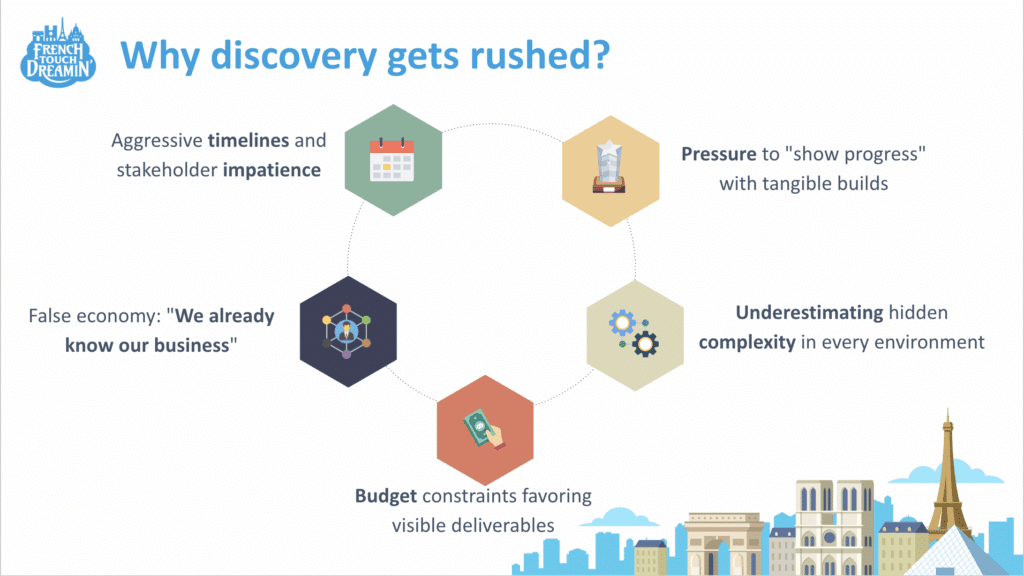
Today, I had the pleasure of presenting this topic at French Touch Dreamin, and I believe it's crucial to share it with you because it goes to the heart of our practices. As a consultant, I'm convinced that the scoping phase is the most critical step in any Salesforce project. It's where we sow the seeds for lasting success, but it's also, all too often, where we set the stage for setbacks and cost overruns.
Faced with the pressure of deadlines and the impatience to "show progress" with tangible deliverables, we all fall, at one time or another, into the trap of a rushed framing.
The illusion of economy and the hidden cost of haste
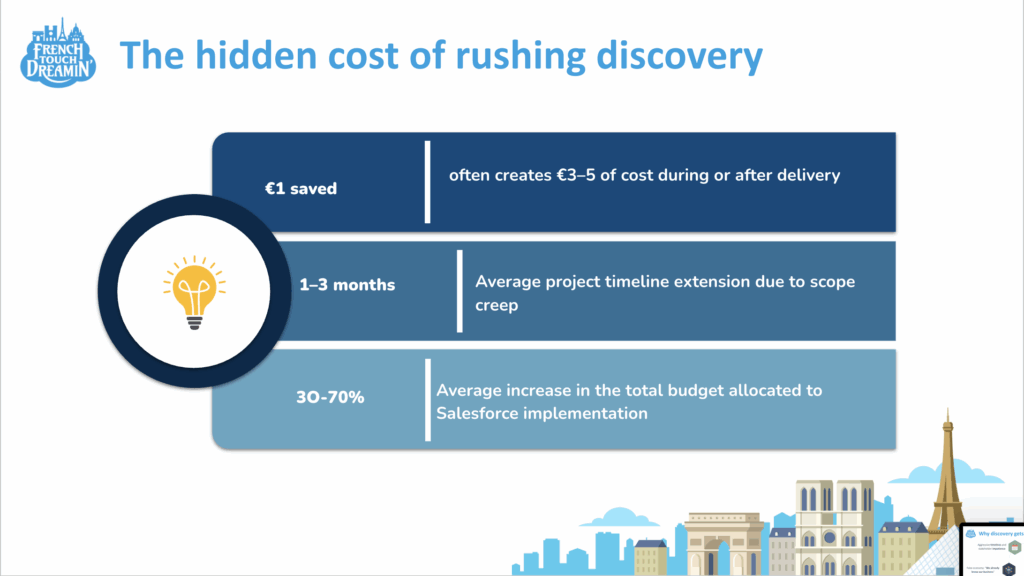
Shortening the framing is a false economy, a false economy. Experience doesn't lie: €1 saved on framing often creates €3 to €5 in additional costs during or after the implementation phase.
Why? Simply because rushing blinds us to the hidden complexity. The result is stark: expect an average budget increase of 30 to 70% and a schedule extension of 1 to 3 months due to scope creep.
If we want to build robust solutions on Salesforce, we must therefore stop viewing scoping as a mere formality. We must approach it as a true art.
Framing: Where logic meets empathy
The art of effective framing lies in the balance between science (the various frameworks and tools) and art( active listening, empathy, and the ability to read between the lines). It is at the intersection of logic and empathy that the real work begins.
A good consultant must first and foremost be a curious person with contextual judgment . Our mission is not just to document, but to understand in depth.
The fundamental problem: solutions instead of needs
The number one challenge on the Salesforce platform is this: customers express solutions instead of expressing their real business needs.
- They tell us, "We want a dashboard ."
- They tell us, "We need Apex to automate this task."
- They tell us: "What we need is this Salesforce feature."
They give us a technical "what" without ever giving us the professional "why".
If we stop at this initial solution, we risk delivering something that doesn't meet the real need, leading to poor adoption or major disappointment. Our job is precisely to intervene at that point to help with reformulation.
Mastering the Art of Framing: The "Why" before the "What"
The art of framing lies in identifying theroot cause of the problem. To do this, one must dig deeper and go beyond the surface.
The golden rule we must adopt is this: Understand the "why" before committing to the "what".
Technique #1: The 5 Whys
The simplest and most powerful technique for achieving this is the 5 Whys method. It allows you to transform a simple request for a solution into a genuine business problem:
- Request (Solution): "We need a dashboard ."
- Why? "Sales managers cannot visualize the business portfolio."
- Why? "We are pursuing opportunities inconsistently."
- Why? "We never clearly defined our sales stages."
In this example, the root cause wasn't a reporting, but a process definition problem. Building the dashboard would have been pointless!
To structure the conversation even better and vary your approach, use, for example:
- Jobs to be Done (JTBD) : Focus on user goals, not features. The formulation: "When [situation], I want [action], so that [result]" is incredibly effective.
Which would mean: When we are in our Monday morning management meeting, we want to immediately identify risky opportunities and understand regional trends so that we can make informed decisions regarding resource allocation.
By using these techniques, we help our clients transform what they believe they want into what they need to achieve their goals. This is the core of our consulting expertise.
The final word: A state of mind
Never forget this mantra: " Mastering the art of framing makes execution smooth. Neglecting it leads to the costly chaos of improvisation."
By mastering the art of framing by seeking out the real need rather than implementing a superficial solution , we identify the real problem, align the teams, and guarantee a solution whose success will be traceable and measurable.
PS: The figures announced in this article come from several sector studies on both Salesforce and digital transformation projects.