
A consultant's CV is often a showcase of prestigious references: impressive client logos, major accounts, large-scale projects, and hard-earned Salesforce certifications. However, the reality of our daily work isn't confined to these pages. It unfolds in the heat of the moment: where we need to refocus discussions in workshops, find the right arguments to inform decisions, guide meetings toward concrete outcomes, and define priorities when multiple urgent matters arise.
If there's one valuable lesson I've learned over the years, it's that our true added value, the one that makes all the difference in the field, isn't found in any of our certifications. Our greatest ally, our shield of serenity, is our consultant mindset.
Consulting is much more than simple technical or functional expertise; it's a strategic partnership that combines analytical rigor, an understanding of organizational dynamics, and enhanced relational intelligence. Today, I propose we take a step back to explore three concrete situations where our approach transforms a project that feels like a struggle into a successful collaboration.
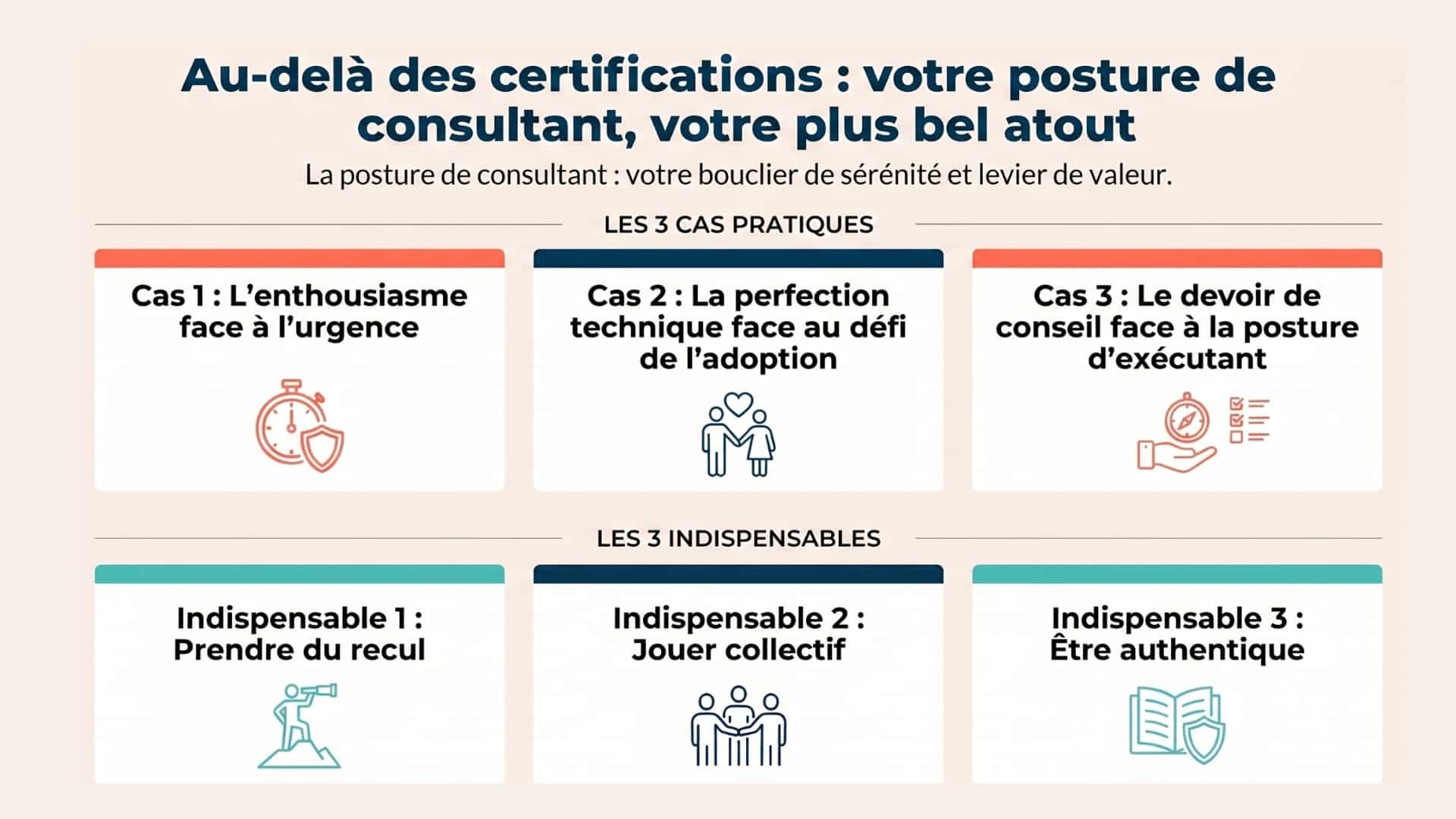
Case #1: Enthusiasm in the face of urgency (Knowing how to say "yes, but...")
The context: Your client is convinced that the latest Salesforce vertical is the immediate answer to all their operational challenges. With the budget allocated and under pressure from deadlines, they want to launch design workshops immediately, without any scoping phase.
The reality on the ground: We sometimes tend to want to say " yes " immediately to reassure our client and demonstrate our responsiveness. However, the real service we provide is laying the foundations for a viable project from day one, even if it means readjusting the initial priorities together.
- Did you know? A rushed or nonexistent scoping almost always results in scope creep, multiplying the cost of adjustments by 3 or 5 during implementation. (This topic was covered in one of my previous articles.)
- The reflex posture: Preventive advice. It's not about hindering the project on principle, but about ensuring that every euro invested will serve a real user need.
- The concrete action: Propose an alignment workshop to define an MVP (Minimum Viable Product). The goal: to first align to ensure we are heading in the right direction, then accelerate afterwards to secure our investment.
Case #2: Technical perfection versus the challenge of adoption ("The industry will adapt…")
The context: The challenge is significant: equipping 200 employees in 6 months. However, no budget is allocated for change management support or in-depth functional workshops. The IT department is managing the project alone, stating: "In any case, the business can't articulate how it operates; we'll design the target system for them."
The reality on the ground: Configuring a technically perfect solution loses all meaning if no one ultimately takes ownership of it. Faced with a lack of alignment or unclear processes, the consultant must position themselves as the guarantor of its practical value.
- The key point to be aware of: If business teams struggle to express how they operate, our role is not to configure blindly, but to ask the right questions to bring out the real needs.
- The posture reflex: Active listening and building bridges between technology and the profession.
Concrete action: Propose integrating key users (champions) into rapid and targeted feedback loops. Validating the solution with those who will use it daily is the best way to ensure adoption during deployment.
Case #3: The duty to advise versus the executor's stance ("Do what I ask…")
The context: During a discussion, your client makes it clear that your design recommendations are secondary. They have made their decision and expect purely technical execution from you: "Configure it this way, I'll deal with the consequences." You know, however, that this decision will generate significant technical debt.
The reality on the ground: This is an uncomfortable situation for any consultant. But simply saying "I warned you" has never rehabilitated an unstable Salesforce instance. Our duty to advise must be expressed with both clarity and empathy.
- The observation on the ground: Clients who promise to bear the consequences often forget that projects have a short memory. Faced with a blockage or anomaly a year later, the initial decision will be forgotten: all that will remain is the observation of an unstable platform.
- The reflex posture: Constructive transparency. The client is looking for a partner in thinking to co-create their strategy, not just a technical intermediary.
Concrete action: Explain the medium- and long-term impacts (maintenance costs, platform limitations, etc.) factually and without judgment. Then formalize these points of concern in writing (for example, with a summary email outlining the options discussed). This allows the client to make an informed decision and strengthens your position as a trusted partner.
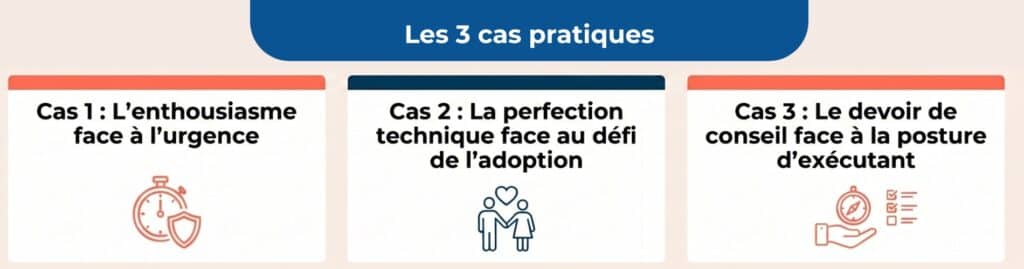
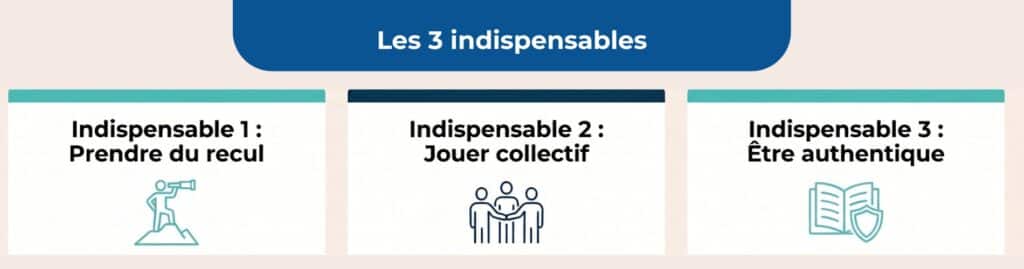
The 3 essentials to stay on course
Faced with the inevitable uncertainties of projects, here are three demanding but beneficial reflexes to preserve your peace of mind and, above all, your effectiveness on the mission:
- Take a step back (and set your own boundaries): the urgency or stress of the project shouldn't become your personal emotional burden. This involves being able to mentally close down tasks at the same time as your computer at the end of the day, so you can return the next day with a fresh, calm, and constructive perspective.
- Teamwork is key: never face doubt or roadblocks alone. Sharing with your team, especially your project managers/directors, is your best anchor. Being part of a strong and cohesive project team provides considerable support.
- Being authentic: admitting uncertainty or asking a question demonstrates professionalism and maturity, far more appreciated than silence that masks a risk. Of course, it's all in the delivery.
To finish
As I write these lines, which mark the end of my adventure at Texeï, I realize with time that my greatest successes are not the linear implementations where everything went smoothly, but those where a solid posture and a strong partnership relationship made it possible to overcome the greatest design challenges together.
A huge thank you to the entire Texeï team and to all of you, readers and members of the Salesforce ecosystem, for these years of learning, memorable projects and stimulating sharing.